
Mayfield Heights City Directory Collections
The core historical shelf is at Cleveland Public Library’s Center for Local and Global History. Its directory holdings guide identifies 83 suburban Cleveland directory volumes covering 1924 through 1963. Larger suburbs received separate titles beginning in 1924, then the titles were folded into East Suburban and West Suburban directories in 1964. A Mayfield Heights search therefore needs the volume’s geographic note, especially for a family recorded under Mayfield Township or a broader eastern-suburb label.
| Collection | Years | Where Held | Access |
|---|---|---|---|
| Suburban Cleveland directory volumes | 83 microfilm volumes, 1924-1963 | Cleveland Public Library, Center for Local and Global History | Check each reel or volume for Mayfield Heights or township coverage. |
| Cleveland-area criss-cross directories | Print: 1923, 1925-1926, 1960-1993, 1996-2010; microfilm: 1923, 1926, 1960-1993, 1996-1998, 2009-2012 | CPL Center for Local and Global History | Search a known or approximate address for a listed residence, business name, or phone. |
| Cleveland telephone directories | 1880-present stated | CPL Center for Local and Global History | Current year in print and prior years on microfilm; a listing is not proof of residency. |
| Cleveland Blue Book | 1885/86-1951 selected editions; biennially 1954-present | CPL, print and microfilm | Use as a social-register lead for selected families, not a complete directory. |
CPL’s property-research checklist adds individual-suburb directories on microfilm for 1924-1974 and East and West Suburban directories for 1964-1980. Some Cleveland paper holdings are incomplete, while microform is more complete. That is a collection fact, not proof that every Mayfield Heights edition contains a given street or name. Write down the exact title, edition year, and place coverage before treating an absence as meaningful.
The Cuyahoga County Public Library genealogy resources add in-library genealogy databases, census and local-history books, maps, and Ohio Memory. Check whether a particular service permits remote use or requires an in-branch visit.
For a view of the library research source, consult the Cuyahoga County Public Library genealogy-resources page.
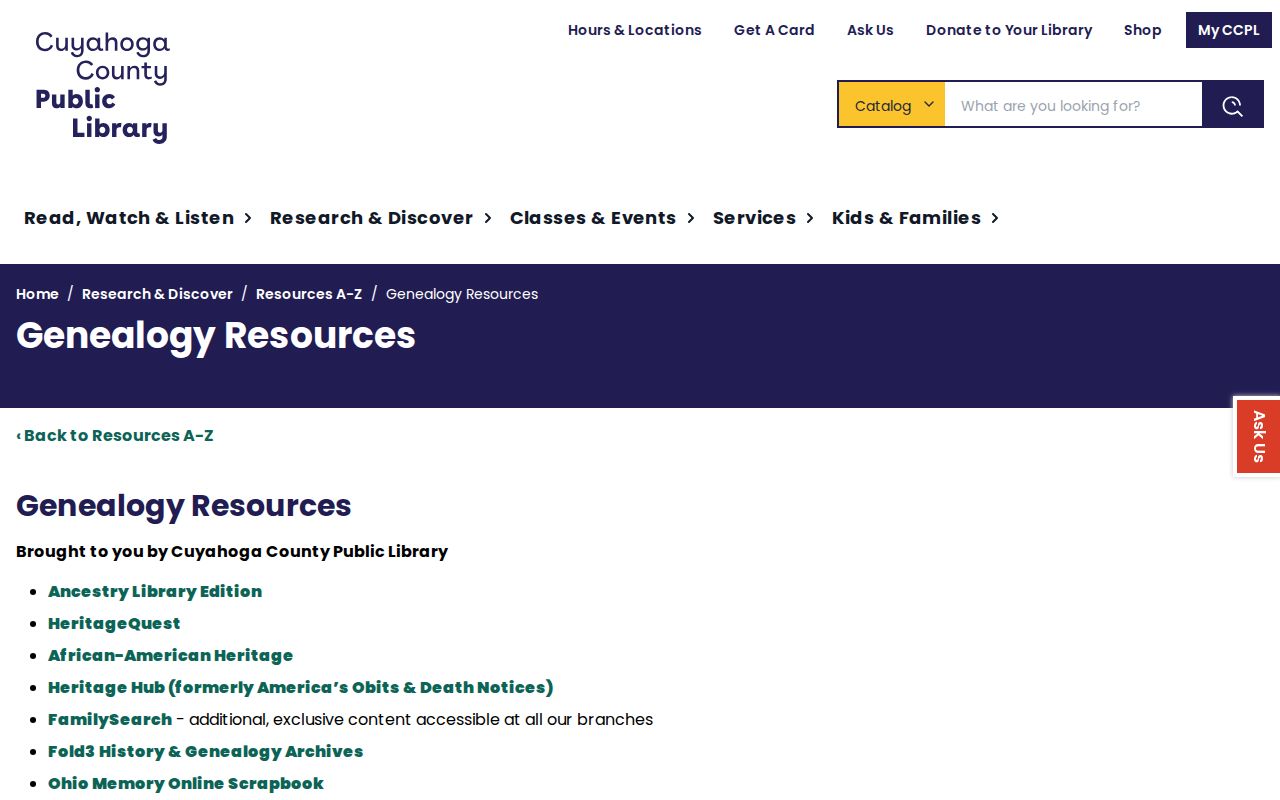
Library collection guidance helps select a likely format before a reader spends time searching the wrong run.
Mayfield Heights Historical Geography
Mayfield Heights was part of Mayfield Township before it became a village in 1925 and a city on July 2, 1951. That sequence explains why an older household may be indexed under Mayfield Township, a suburban title, or a nearby-community grouping instead of the modern city name. State Road, the older name for Mayfield Road, is another term worth retaining in search notes.
The Mayfield Township Historical Society provides the local geographic bridge. Its research library and Bennett-VanCuren Historic House are at 606 SOM Center Road in Mayfield Village. The organization asks visitors to call 440-461-0055 or make an appointment before traveling. It is a useful route for township-era family, school, church, map, photograph, and house-history questions a directory cannot settle.
Its former-township coverage reaches today’s Mayfield Heights, Mayfield Village, Gates Mills, Highland Heights, and parts of Lyndhurst. A shift among those labels can reflect changing jurisdiction or collection practice, not necessarily a family move.
For local-history context, see the Mayfield Township Historical Society.
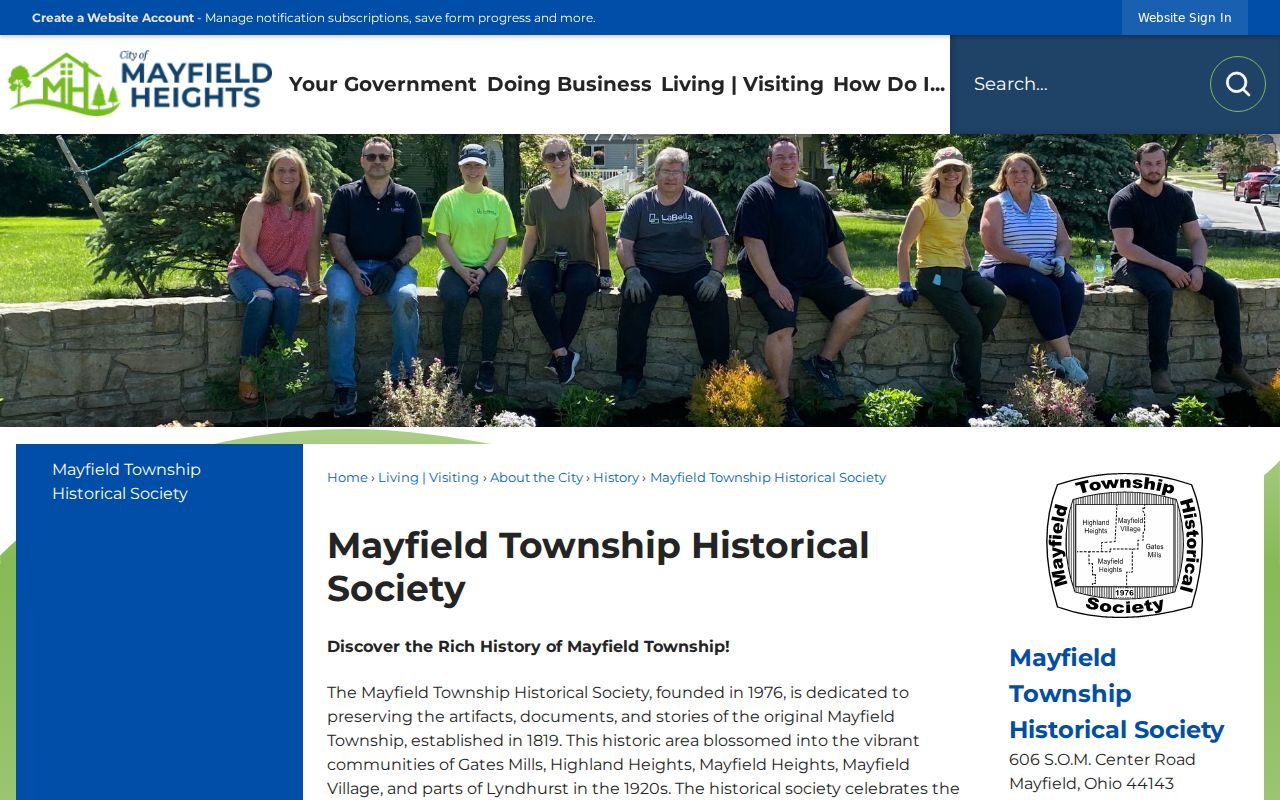
That historical geography is a practical way to broaden a city-directory search without treating nearby community records as identical.
Reading a Mayfield Heights Directory
A directory entry has to be read in its own edition’s terms. CPL’s inspected guides support an inventory of surname and given-name form, spouse notation when used, occupation or employer line, residence address, widow marker, page, edition, publisher context, and the front-matter abbreviation key. They do not verify an all-purpose homeowner symbol or a universal boarding abbreviation for Mayfield Heights. Photograph or note the key before expanding any shorthand.
| Printed name | Record the spelling, initials, and name order exactly as shown. |
|---|---|
| Spouse notation | Capture it when the edition uses it; wives’ given names begin in the Cleveland City Directory in 1929. |
| Occupation line | Copy the occupation or employer wording as printed, without adding an interpretation. |
| Residence address | Keep the number, street form, locality label, edition, and page together. |
| Widow marker and abbreviations | Transcribe only after checking the abbreviation key in that specific volume. |
- Criss-cross directory
- An address-arranged directory. It can start with a house number and return the listed residence, business name, or telephone where listed.
- Alphabetical listing
- The name-order portion of a directory, useful after an address-order result supplies a surname.
- Abbreviation key
- The edition’s explanatory list, usually in front matter. It controls what a mark or shortened word means in that volume.
Two limits matter. The public digitized source is a 1954 business listing, not a Mayfield Heights household entry. Also, an indexed name or telephone listing is a historical lead, not a complete account of a family or a confirmation that anyone remains at that address.
See CPL’s digitized 1954 directory scan for the printed-directory layout.
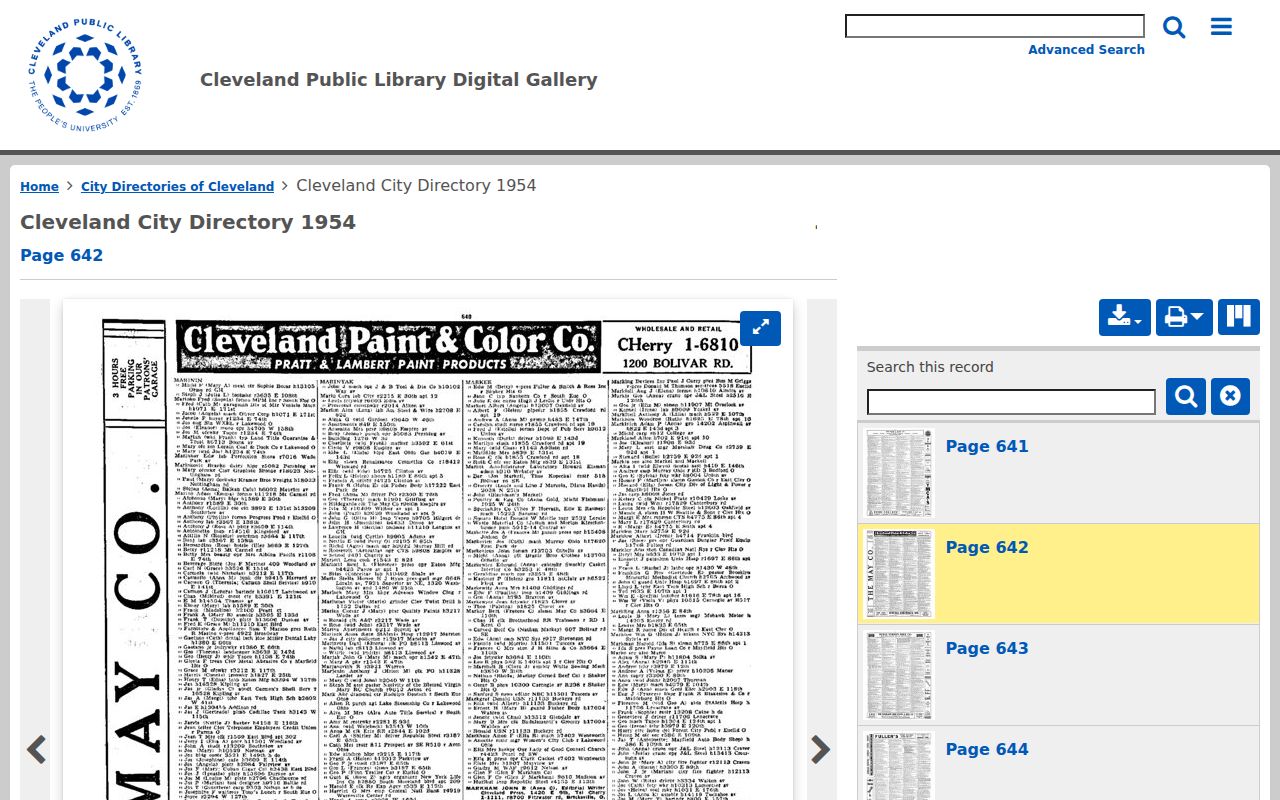
The scan makes the edition, page, and printed context part of the research note rather than an afterthought.
Mayfield Heights Digitized Directory Evidence
CPL’s digitized 1954 material is a useful example of printed layout, but the verified Mayfield Heights line is a business-category listing. Its defensible details are the printed name form, commercial category, street number and street, locality label, edition or year, page, and publisher context. It does not establish an individual’s residence, family relationship, or current status.
That distinction matters when copying a result into a family-history note. Save the image or page reference with the edition and describe it as a business listing. CPL also directs users of a later 1974 directory record toward the East or West Suburban Directory route, another reason to follow the collection title instead of assuming one city label fits every year.
Mayfield Heights Address-Order Directory Clues
For a known house number, the criss-cross run is the more direct starting point. CPL reports print holdings for 1923, 1925-1926, 1960-1993, and 1996-2010, with microfilm holdings that also include 1923, 1926, 1960-1993, 1996-1998, and 2009-2012. Search the closest available year, then take the listed surname back to the alphabetical part of the same edition.
This address-order layer began appearing at the end of Cleveland and most suburban volumes in 1929. It may identify the listed subscriber or occupant at a particular address, but it does not list every household member. A missing result can reflect the available edition, an unlisted telephone, or a coverage boundary. Preserve the address spelling and do not turn that absence into a conclusion about a person.
Trace a Mayfield Heights Directory Household
Historic directory volumes work best as a sequence of dated observations. Start with the address details held by the Cuyahoga County Fiscal Officer, use the directory layer for a listed name, then use a census and a recorded transfer to test separate questions. A directory identifies a listing, a census describes a household, and a deed records an ownership event. Those are different types of evidence.
- Use MyPlace to record the current street, house number, parcel ID, legal description, and any alternate road name.
- Search the nearest criss-cross volume for the number, then use its listed surname in the alphabetical directory.
- Move through adjacent editions one at a time, recording the exact title, year, page, spelling, and address form.
- Pair a directory period with the 1950 Census or another released census schedule to compare age, birthplace, occupation, and household composition.
- Use the Recorder’s Official Records Search to distinguish a property transfer from a change in listed occupant.
A disappearance from a Mayfield Heights directory can mean a move, a changed listing, a changed boundary, or another coverage difference. It does not by itself establish death or a sale. The property chain and census comparison are the checks that keep the household trail from becoming a guess.
The National Archives 1950 Census research page supplies the released named schedules and enumeration-district maps.
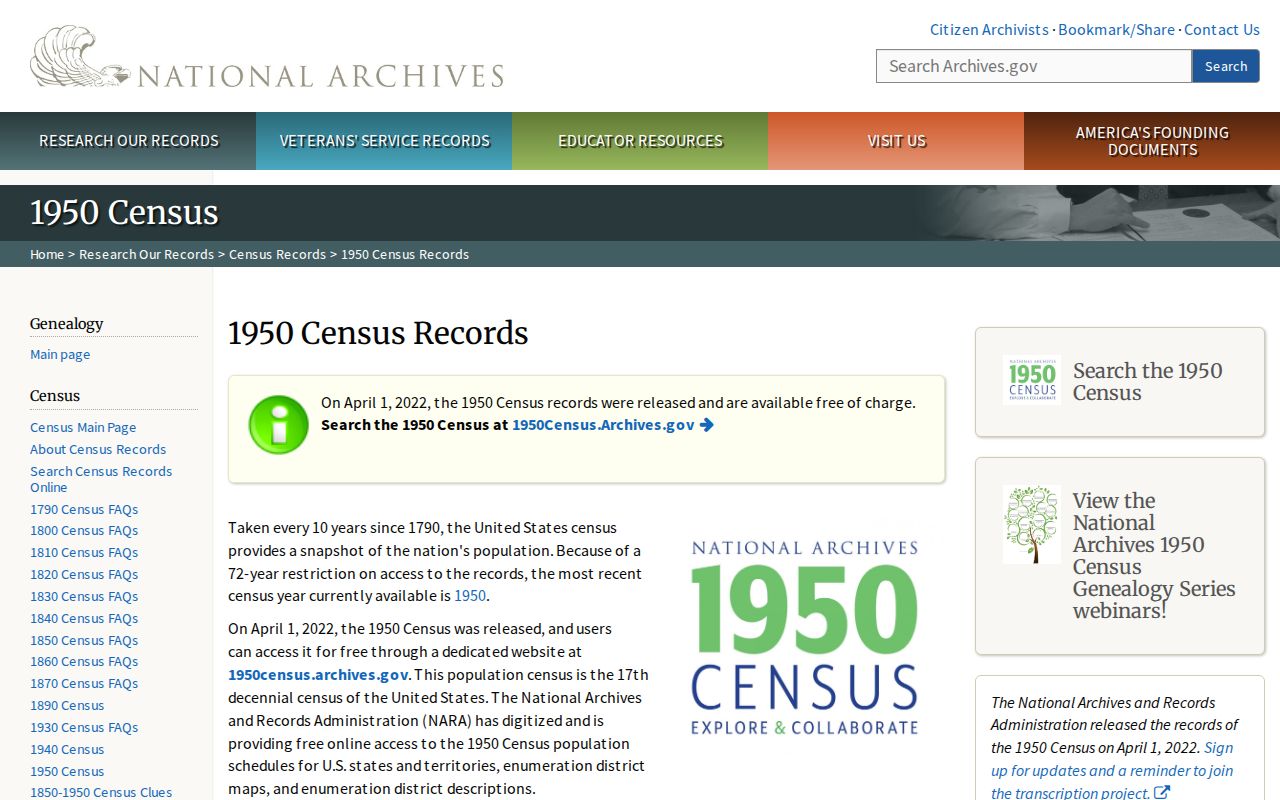
Census records add household context to a directory listing without replacing the directory’s year-specific address evidence.
Mayfield Heights Directory Timeline
The documented milestones below help choose a search term and a likely directory shelf. They are a chronology of geography and collection practice, not an assertion that a separate Mayfield Heights volume exists for every date.
- 1819: County commissioners established Mayfield Township.
- 1924: Larger suburbs began receiving separate directories in CPL’s documented directory history.
- 1925: Mayfield Heights incorporated as a village.
- 1929: Cleveland directory volumes began showing wives’ given names, and most suburban volumes began adding criss-cross sections.
- 1951: Mayfield Heights became a city on July 2.
- 1964: Separate suburb titles were consolidated into East Suburban and West Suburban directories.
Record the title page alongside the page you use. CPL cautions that Cleveland proper and suburban holdings do not have identical continuity, so a run for one cannot be projected onto the other.
Mayfield Heights Directory Supporting Layers
Telephone directories offer a long residential and business listing run, but a listed number does not prove residency. The Cleveland Blue Book is narrower still: it is a social register with selected local families, not a universal Mayfield Heights directory. Use either source to generate a date-bound lead, then corroborate it with a census, parcel record, recorded document, or the relevant custodian record.
Cuyahoga County Archives is a complementary appointment-based stop for original maps from about 1860-1945, tax records from 1819-1986, appraisal cards from about 1935-1970, atlases, historical directories, and property-tax history. Its property research information identifies the address, phone, and appointment requirement. The Mayfield Heights historical shelf and County Archives each answer different parts of an old-house question.
Note: A stated collection year shows a holding range, not guaranteed indexing or city coverage for a particular name.